Select Board approves proposal for a permanent Civilian Police Advisory Commission

The Arlington Select Board, during its Wednesday, February 23, 2022 meeting, unanimously approved a proposal by the Civilian Police Advisory Board Study Committee to create a permanent Civilian Police Advisory Commission to provide opportunities to increase trust between residents—particularly, though not solely, those who are LGBTQIA+, BIPOC, and/or living with a disability—and police.

The Study Committee was created by the special 2020 Town Meeting to determine, in part, whether the town would benefit from the creation of a permanent Civilian Police Advisory Commission. The Study Committee has 17 members. Seven were appointed by various town boards and commissions including the Rainbow Commission, Envision Arlington Standing Committee, the Envision Arlington Diversity Task Group, the Human Rights Commission, the Disability Commission, the Board of Youth Services, and the Council on Aging. The Rainbow Commission’s appointee to the Study Committee has been co-chairing the Study Committee since last March. 

The Study Committee has met 16 times since March and also held 14 listening sessions with town residents and employees, including one for LGBTQIA+ residents last November. Among the Study Committee major findings were the following: 

  • The Arlington Police Department’s Professional Standards Unit, which investigates complaints from the public, stands out among comparable communities for the thoroughness of its work. Each and every complaint that comes to the department, regardless of how it is communicated to the department, is thoroughly investigated. 
  • Second, some of the complaints and concerns held by residents are never communicated to the police. 
  • Third, without exception, each of the instances the Study Committee learned of by which residents had complaints but did not feel comfortable reporting them to police involved residents who are Black, Asian, LGBTQIA+, and/or living with a disability. 

The 2022 Town Meeting, which will be held in April, must give final approval to the proposal to create a permanent Civilian Police Advisory Commission.

Transgender Day of Remembrance’s Boston Origins

DID YOU KNOW that Transgender Day of Remembrance grew out of the Greater Boston’s LGBTQIA+ community’s shock at the 1998 murder of one of our own—34-year-old Rita Hester—combined with intense anger over Boston media’s callous reporting of her murder? 

Rita was a singer who routinely performed at Jacques Cabaret and hung out at Bunratty’s, a mainstay of Boston’s influential music scene. She moved back and forth with ease among Boston’s predominantly white gay community and its African American, Latinx, Asian, and other queer communities of color. She was routinely described by her family and friends as extroverted, ebullient, gracious, glamorous, sassy, and kind. In short, if you were out and queer in the 1990s, you may not have known Rita personally, but you had likely heard of her. 

So when friends learned of her horrific death by stabbing at her Allston home on November 28, 1998, there was widespread shock—even though another transgender woman, Monique Thomas, had been murdered in Dorchester just three months prior on September 11, 1998. 

As Grace Stowell, a longtime member of Boston’s queer community and executive director of BAGLY recalled for the Daily Beast in 2017: “There was a sense of ‘How could this happen to this wonderful person who wasn’t harming anyone [and] who was such a fixture in the community?’” 

Hester’s murder was widely covered by local media, which misgendered her and defined Hester by her hardships in life as opposed to her triumphs. In a story titled, “Stabbing victim a mystery to many,” the Boston Globe described Hester as “a man who sported long braids and preferred women’s clothes” and noted that “Hester was a mystery to those around him—so much so that, until his body was found on Saturday, many in the building on Parkvale Avenue believed Hester was a woman.” 

Coverage in the city’s gay and alternative press wasn’t any better, as described by longtime activist Nancy Nangeroni in her essay, “Rita Hester’s Murder and the Language of Respect.” Bay Windows misgendered Hester and put her name in quotes. In a follow up editorial written in response to criticism of the coverage, the paper’s editor apologized for the use of quotes around Rita’s name and said that there was “no disrespect intended” but went on to accuse transgender activists of “paranoia.” 

When the Boston Phoenix, one of the country’s most venerable alternative news weeklies, finally wrote about Hester, it wasn’t to cover her death. Instead, in a piece titled “Displaced Anger: Is Rita Hester’s murder being eclipsed by the transgender community’s grammatical agenda?,” the paper weighed in on the transgender community’s angry response to how Rita’s death was being covered. 

Just days after Hester’s murder, a community meeting was held to vent anger about the media’s handling of Hester’s death. Attended by 60 people, including Hester’s mother, brother, and sister, and covered by the media itself, the meeting led to the organization of a community memorial and vigil to mark Hester’s life. It prompted additional coverage of Hester that contributed to public conversation about transgender people and the need to respect their gender identities. 

But this wasn’t the first time that Boston’s queer and transgender community had come together to organize in response to the murder of one of their own. In 1995, Chanelle Pickett was strangled to death by William Palmer. The community held a vigil at Arlington Street Church and among those who spoke out the need for justice was Rita Hester. 

“I’m afraid of what will happen if [Palmer] gets off lightly. It’ll just give people a message that it’s OK to do this. This is a message we cannot afford to send,” Hester told the LGBTQ paper In Newsweekly. 

Two years later, during his 1997 trial, Palmer’s attorneys claimed that his attack on Pickett was the result of his shock at learning that she was transgender. The jury refused to convict Palmer of murder or manslaughter, opting instead to find him guilty of just assault and battery. While the community was both shocked and angered by the verdict, it was not enough to prompt an on-going response to anti-transgender violence. 

What finally did it may have been the juxtaposition of community response to Hester’s death with that of the broader LGBTQIA+ community’s response to the murder of Matthew Shepard, a gay University of Wyoming college student who was tortured to death by two men motivated by anti-gay hatred. Shepard’s murder took place just three weeks before Hester’s and garnered international media attention. It also prompted renewed activism to enact hate crimes legislation. 

Ten years after his murder, Congress passed the Matthew Shepard and James Byrd Jr. Hate Crimes Prevention Act, which added crimes motivated by a victim’s actual or perceived gender, sexual orientation, gender identity, or disability to federal hate crimes law. (James Byrd, Jr. was an African American who was murdered by three white supremacists in Texas in 1998. The gruesome crime led to the passage of hate crimes legislation in Texas that became a model for the federal law.) 

As Gunner Scott, an activist who helped organize local protests against media coverage of Hester’s death and later became the chair of the Massachusetts Transgender Political Coalition told Bay Windows on the 10-year anniversary of Hester’s death, the contrast between community and media response to both events was galling. “[Shepard’s murder] was such a galvanizing event, and it changed how folks started to see violence against gay people … particularly in the media, that level of empathy changed. And [it angered people] to have that stark contrast of the lack of empathy towards Rita and who she was.” 

As a result, Hester’s story became a topic of conversation on AOL’s Transgender Community Forum, which was managed by Gwendolyn Smith, a transgender activist, writer, and graphic designer. Those online discussions gave rise to the creation of a website Remembering Our Dead as well as a community vigil in Hester’s honor in San Francisco in 1999, where Smith lives. 

That website and the vigil in San Francisco became the model for the Transgender Day of Remembrance, which is now held annually on November 20. 

We are co-sponsoring co-hosting a Transgender Day of Remembrance event with Lexington Pride from 7-8:30pm via Zoom on Friday, November 20, 2020. Speakers will talk about how to turn away from anti-trans violence and toward a culture of inclusivity. The event will also include a reading of names of those no longer with us. RSVP here to get the Zoom link.

LGBTQIA+ Pride Banners!

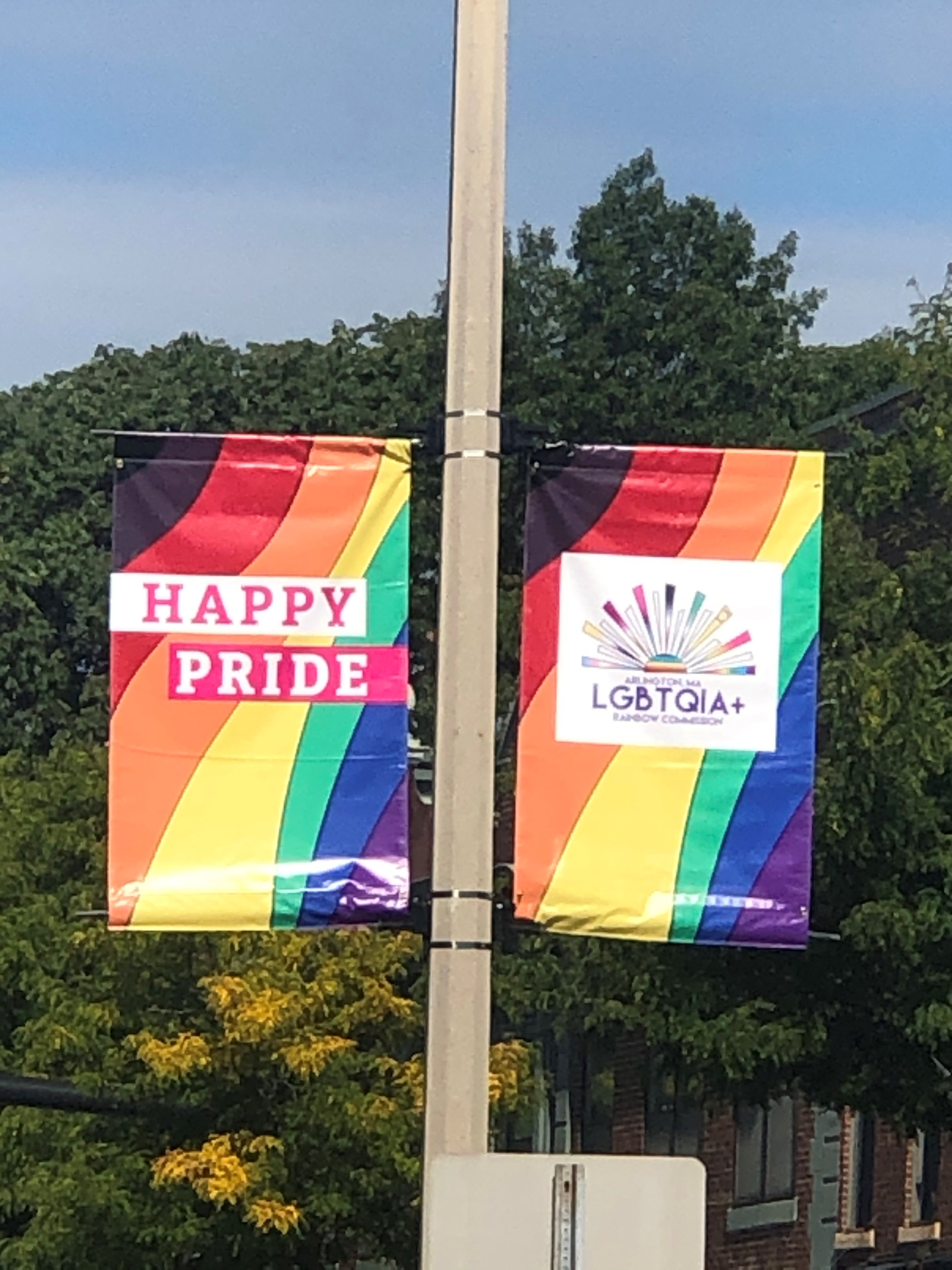
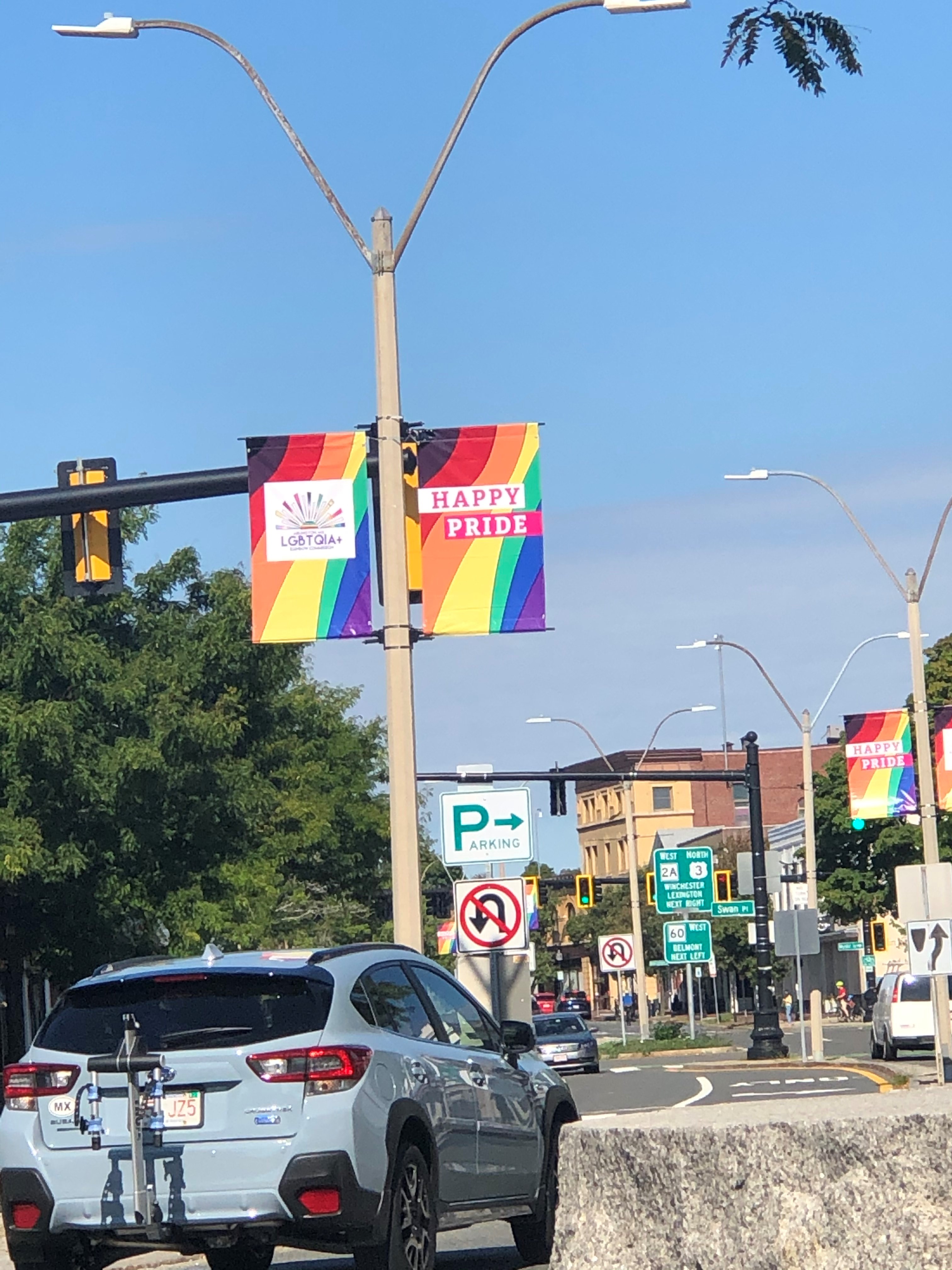
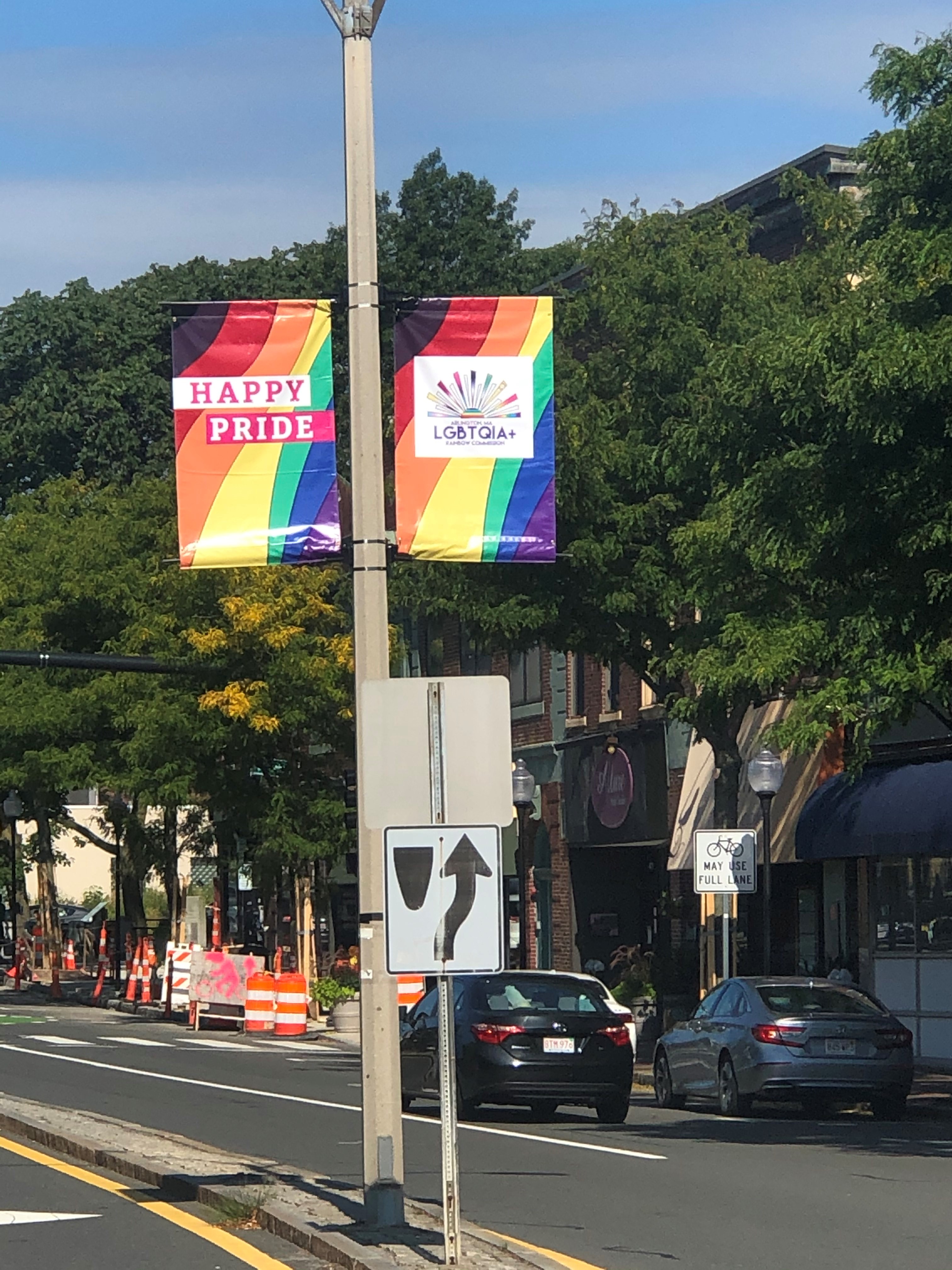
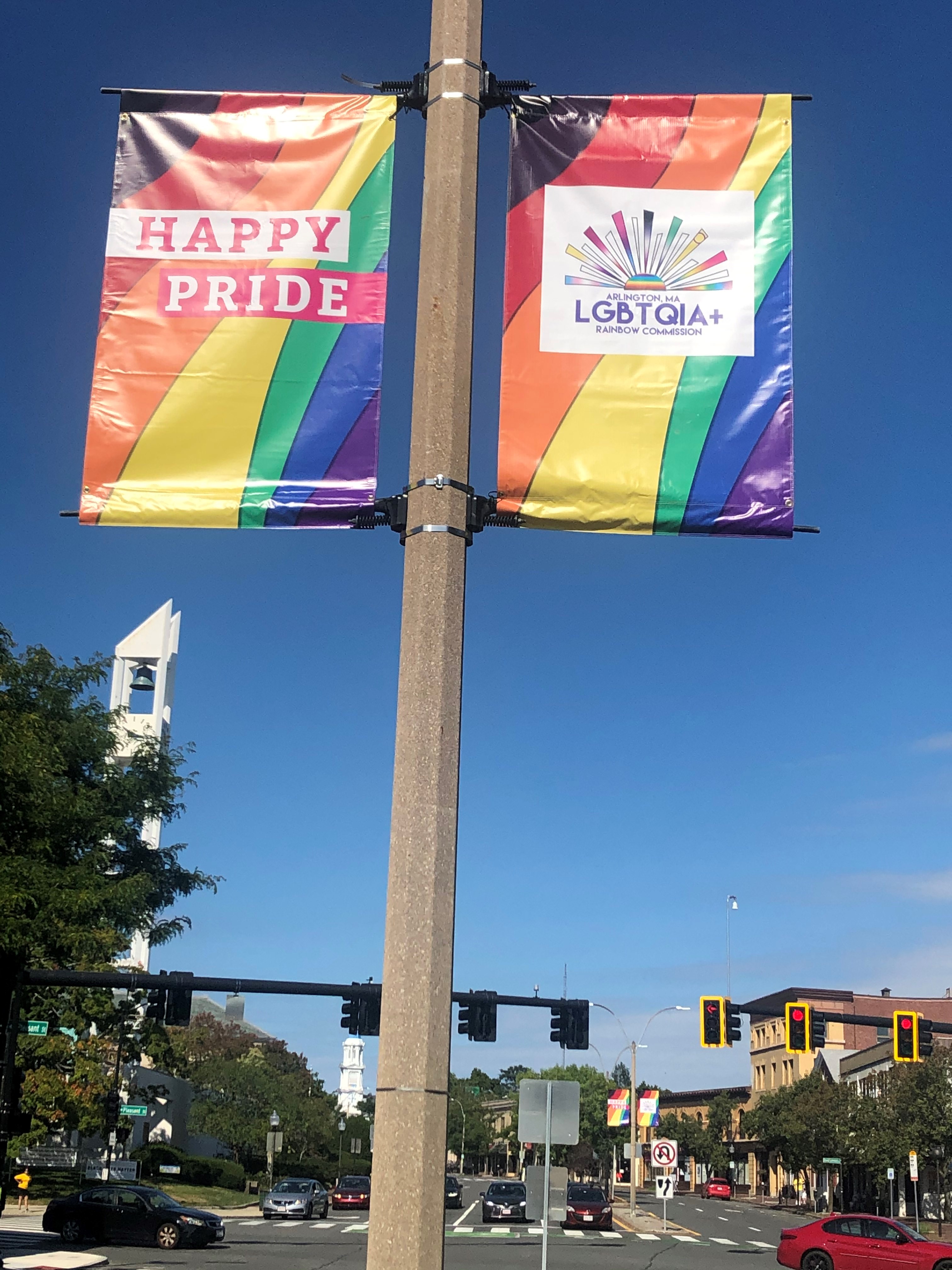
This year, for the first time, Arlington proudly flew LGBTQIA+ Pride banners in the town center! They were up for the month of September. Next year, they’ll be displayed throughout the month of June. We want to offer our sincerest thanks to all those who generously donated to the LGBTQIA+ Rainbow Commission for the purchase of our banners, which will be used for years to come.

Arlington-Belmont Crew Team

Arlington Human Rights Commission

Laurie Caldwell & Anna Watson

Calvary Church, United Methodist

Ellenhorn LLC

State Senator Cindy Friedman

Patricia and Edward Harlow

David Lenoir Homes

Krattenmaker O’Connor & Ingber PC

Lisa Krinsky

State Rep. Sean Garballey

Bill Gardiner

Molly & Daniel Gillis

Mel Goldsipe

S.R. Nelson Marrufo

Charlotte and James Milan

Heather Phelps

State Rep. Dave Rogers

Andy Rubinson and Robert Davison

Elaine Shea – In honor of her grandchild

Cynthia S. Tavilla, PSY.D.

Richard and Patty Jo Watson

Attorney Mary Winstanley O’Connor

Do you have a story to tell? AnOther Suburbia wants to hear it.

AnOther Suburbia is an oral history and theater project documenting LGBTQ+ and marginalized experiences in American suburbs. They are currently seeking volunteers from the Greater Boston Area to share their stories with our team.

AnOther Suburbia explores the diversity of race, sexuality, and gender expression in American suburbs and the unique experiences, identities, and communities that form in these areas. The team is interested in speaking with individuals who have had LGBTQ+ experiences or experiences of “otherness” and spent a meaningful part of their life in a suburb of Boston. Participants in this project may come from a variety of backgrounds, have a range of experiences, or identify in different ways. How they define “LGBTQ+,” “other,” and “suburb” are also up to them. AnOther Suburbia is interested in exploring the different ways people imagine these words and identities.

Participants in this project may come from different backgrounds, have a range of experiences, or identify in different ways. How you define “LGBTQ+,” “other,” or “suburb” is up to you. Through AnOther Suburbia, the team will document your stories, preserve them in a public digital archive, and ultimately, incorporate parts of interviews into a work of public-facing theater. Interviews will be conducted virtually (due to COVID-19) in August, September, and October 2020.

Interviewers will reach out to you personally if they are able to feature your story in this project. When selected, participating narrators will be provided official forms outlining consent and details of the project. They may not be able to feature all interested participants, but we sincerely appreciate all participants’ openness to sharing initial interest on this form.

If you have any questions about the project, please feel free to email AnOther Suburbia at: betweentheactsproject@gmail.com or visit the project web page at: https://www.betweentheactsproject.org/another-suburbia.

Statement on verbal attack and use of a homophobic slur against a town resident.

Dear Arlington friends and neighbors, 

The Arlington LGBTQIA+ Rainbow Commission condemns the recent hateful verbal attack and use of a homophobic slur against a town resident. The verbal attack was captured on video and posted to the Arlington MA Current Residents group on Facebook on Tuesday, July 21, 2020. It took place on Massachusetts Avenue near the intersection with Park Avenue. 

In a description of the incident that accompanied the video, the poster wrote: “[T]he guy behind me in line at the grocery wasn’t keeping a distance, and had his mask only halfway on. I asked him to put his mask on and he got supper aggro. He followed me outside, got all in my face and threatened to fight me, but backed off when I pulled my phone out.” 

Everyone in Arlington has the right to participate in public settings free from violence, discrimination, and abuse based on identified or perceived sexuality or gender identity/expression. This incident is a reminder that anti-LGBTQIA+ bias remains commonplace and much work remains to become a safe, supportive, and inclusive town. The LGBTQIA+ Rainbow Commission is committed to this work and welcomes all members of the town community to join us. 

Here are ways you can help. 

First, educate yourself. Verbal attacks like these are often minimized as having caused no harm. But being the target of anti-LGBTQIA+ bias or merely anticipating such bias in public settings has been linked to higher rates of depression and anxiety among LGBTQIA+ people. 

The use of slurs targeting people based on their identified or perceived sexuality or gender identity/expression, as well as their race, gender, religion, disability, or ethnicity is designed to humiliate and dehumanize the target of abuse. It is also meant to instill fear among other members of the targeted group

Although LGBTQIA+ people comprise less than five percent of the U.S. population, nearly 20 percent of hate crimes reported to the FBI in the U.S. are motivated by anti-LGBTQIA+ bias

Arlington has a thriving, active, and resilient LGBTQIA+ community. Please join us and learn more at the next Arlington LGBTQIA+ Rainbow Commission monthly meeting on Thursday, August 20 via Zoom at 6:30pm

The town of Arlington values equity, diversity, and inclusion. The Arlington LGBTQIA+ Rainbow Commission supports these values by promoting the full inclusion of LGBTQIA+ individuals and groups in Arlington through affirming policies and programs, resources, advocacy and community building.